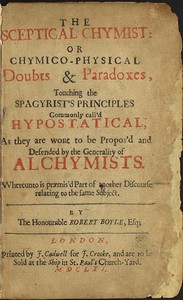
The Sceptical Chymist: or Chymico-Physical Doubts & Paradoxes, Touching the Spagyrist's Principles Commonly call'd Hypostatical; As they are wont to be Propos'd and Defended by the Generality of Alchymists. Whereunto is præmis'd Part of another Discourse relating to the same Subject.
About this book
"The Sceptical Chymist" by Robert Boyle is a scientific work published in 1661. Written as a dialogue between five characters in a garden, this groundbreaking book challenges ancient theories about matter's composition. Boyle proposes that matter consists of moving corpuscles and clusters, while rejecting both Aristotle's four elements and Paracelsus' three principles. Instead, he defines elements as "perfectly unmingled bodies," laying foundations that would help establish modern chemistry. The work's influence gradually displaced centuries-old doctrines about the fundamental nature of matter. (This is an automatically generated summary.)
FocusReader opens The Sceptical Chymist: or Chymico-Physical Doubts & Paradoxes, Touching the Spagyrist's Principles Commonly call'd Hypostatical; As they are wont to be Propos'd and Defended by the Generality of Alchymists. Whereunto is præmis'd Part of another Discourse relating to the same Subject. in a reading surface tuned for restless attention:
- Anchor emphasis — a bold front-half on each word steadies your eye.
- Read-aloud — sentence by sentence, with the line highlighted, free.
- Page-flip mode — a real page at a time, not endless scroll.
- Pomodoro sprints — short, finishable reading blocks.