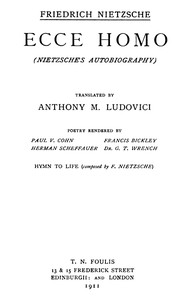
Ecce Homo: Complete Works, Volume Seventeen
About this book
Nietzsche wrote *Ecce Homo* with the subtitle “How One Becomes What One Is,” and it’s less a conventional autobiography than a manifesto of self-creation. He dissects his own books with brutal clarity, revaluing everything from his diet to his philosophy. For a restless reader, this is the book to read when you’re tired of polite introductions to Nietzsche. It’s the raw, unfiltered version—the philosopher speaking directly, often arrogantly, about why his ideas matter and how they should be read. It’s energizing because it refuses to be neutral.
The prose is dense and aphoristic, which is where FocusReader’s **anchor emphasis** helps: you can highlight a single sentence and let the rest of the page dim, forcing your attention to one claim at a time. The **Pomodoro sprints** are useful here too—Nietzsche’s chapters are short but packed, so 20-minute bursts keep you from drifting through his provocations.
Honest note: Nietzsche’s self-praise can feel jarring, especially if you’re unfamiliar with his earlier work. Some readers find the tone off-putting or even delusional. That’s part of the point—he’s performing the courage he writes about. If you want a calm, balanced biography, this isn’t it. If you want to watch a philosopher try to become his own ideal, it’s riveting.
- Meditations — Marcus Aurelius, Emperor of Rome
- The Confessions of St. Augustine — Augustine, of Hippo, Saint
- A Pickle for the Knowing Ones — Dexter, Timothy
FocusReader opens Ecce Homo: Complete Works, Volume Seventeen in a reading surface tuned for restless attention:
- Anchor emphasis — a bold front-half on each word steadies your eye.
- Read-aloud — sentence by sentence, with the line highlighted, free.
- Page-flip mode — a real page at a time, not endless scroll.
- Pomodoro sprints — short, finishable reading blocks.